As funny as Role Models is--and the unrated version I watched is one of the funniest, grittiest comedies I've seen since Bad Santa--the real theme of this flick is a very serious one: selfish adults who live to satisfy their own interests are fucking up our kids.
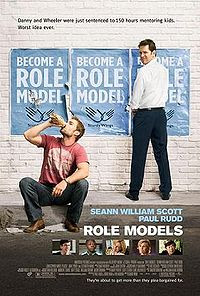 Mothers who ignore their kids in order to keep the step-father happy: Check.Self-involved step-fathers more interested in turning someone else's kid into a new, younger version of himself: Check.Smug, self-appointed heroes in society, who pretend to "do it for the kids" while really taking care of their own needs: Check.Adults who are so jaded and annoyed by society that they don't even notice children until forced to: Check.Damn, I'm sorta depressed now...did I mention how incredibly funny this movies is? It's one of the best written comedies I've watched in years.
A flick staring Mick Jagger as the time traveling mercenary who kidnaps Emilio Estevez into the future so his body can serve as the host for the wealthy Anthony Hopkins sounded like such a good way to spend a Friday night.At the time. (No pun intended.)
 Freejack
,
a dystopian nightmare set in 2009, still haunts me.
I recall vividly the angst felt during my years in junior high school, when I worried obsessively over falling in love. The worry wasn't that I wouldn't find affection; it was the issue who. The pre-teen me had a theory: You can't choose with whom you fall in love. It simply happens.Falling in love with the wrong girl could be a disaster. If The One didn't love me back, I might lead a life of loneliness and misery. If the love of my life wasn't considered attractive by my peer group, I'd catch hell from my friends. I wondered: if the girl I'm smitten by isn't a nice girl, could I accept that and be happy simply because we were in love?"What if..." It's the kryptonite of an obsessive-compulsive pre-teen.Michael Berg (played wonderfully as a youth by actor David Kross) spends a lifetime working through the "what if's" of his teen years, and how they changed him. After stumbling into a sexual affair with an older, emotionally distant woman, only to be abandoned by her months later, Michael is emotionally wounded. He changes; the optimistic, care-free youth was transformed into a jaded, cold adult. During a chance encounter with Hannah, his former lover, a 20-something Michael balks at the opportunity to help her during a time of crisis in her life. He's ashamed that he once loved a woman who, as the story reveals, had participated in efforts to imprison and kill hundreds of Jews during WW2. The Reader is a complex, tale that focuses on the complications of being human. Hannah was often the victim of circumstance, choosing this job or that job based on the fact she was illiterate. Shamed by being unable to read, Hannah did as her employers told her, was dependable and did her job well. Employed as a Nazi prison guard in wartime Germany, Hannah performed her duties as instructed. "We were told to keep order," she said. And to her, that meant some people had to die.Both Michael and Hannah seem like good people who under different circumstances would be very different people. But, the characters are what they are: the results of their environment, and the sum of their lifetime choices and experience. How they answered the "what if" question determined who they became.
"Dear Mr. Vernon, we accept the fact that we had to sacrifice a whole Saturday in detention for whatever it was that we did wrong. What we did was wrong. But we think you're crazy to make us write this essay telling you who we think we are. What do you care? You see us as you want to see us... in the simplest terms and the most convenient definitions. You see us as a brain, an athlete, a basket case, a princess and a criminal. Correct? That's the way we saw each other at seven o'clock this morning. We were brainwashed."~ The Breakfast Club, 1985Some things never change. And according to American Teen, an almost-too-slick documentary about kids in Warsaw, Indianna, high school stereotypes remain the same. Even decades after the iconic John Hughes movie.The film itself is interesting, even if most of the kids are not.
Live bloggin' Quarantine:
(It's a more manly way to divert my eyes from the screen, rather than putting my hands over my face during scary scenes.) Things about zombie flicks that scare me:
1. The animal-like growl that comes from zombies just before they attack.
2. The sound of flesh being torn from the neck of the person being eaten.
3. Thick, rabies-like foam that drips from the mouths of the undead. 4. Kids that turn into zombies.
What takes those who are not yet infected so long to figure out what's going on? In real life, if I see a 60 year old woman bite into the neck of a person like it's a rib-eye, I'm screaming:..."Zoooommmbie!!" ...and running like hell.Twenty minutes into the movie, and Mrs. Film Geek has already passed judgment: "It's no 28 Days!" she says. I think the hand-held camera effect reminds me of Cloverfield.Dude, uhhh.....that federal agent just drilled into that zombie's brain with a power-tool. That's worse than the foamy mouth thing.Zombies make me scream like a girl.Note to self: If I ever stumble across a kid standing in a dark corner, staring blankly at me with blood and foam dripping from her mouth, DO NOT try to pick her up and carry her to safety. THE KID IS A ZOMBIE!Biological warfare and doomsday cults are good for nothin' but zombies!
Since posting the trailer to The Wild, Wonderful Whites Of West Virginia last Friday, this blog has been overrun (if, by "overrun," I mean triple the daily traffic) by folks searching for a peek into the hillbilly lifestyle. (At least what they presume is the typical hillbilly lifestyle.)As I mentioned when I posted the trailer, I wasn't sure what to think. The footage was off-putting, yet strangely interesting. The behaviors depicted by the Whites were clearly over the top, but I've known others with similar lifestyles and world views; sure, the family presents as an exaggeration, but not so much that most of us living in Appalachia don't recognize something familiar about Jesco and his clan. Step outside Taylor Books, the Huntington Mall or off a college campus, then drive a few miles off the Interstate and see how long it takes you to find Jesco. He's there.Appalachian Being recently published a terrific commentary about this (which can be found here) in which blogger BuzzardBilly articulates quite well how cultural, societal and educational paths cross to produce the exaggerated, stereotypical lifestyle of the Whites. It's insightful, and well worth the read.But a post published Friday by Spike Nesmith, on his blog, Blog! The Musical, caused me to flip my thoughts a bit on the White saga. In his post, Nesmith confesses to searching for and watching the video-taped death of comedian Tommy Cooper, and asks the question that made me care less about the behavior of the White family, and become more interested in the people a-google-in' up their movie trailer : "What draws us to these clips?" What is it about the unusual, the forbidden and the shocking that causes people to seek out and watch activity we'd otherwise turn our eyes away from if witnessed in real life? It's an interesting question that deserves a thoughtful, genuine answer.Vonnegut's Cat's Cradle may hold a clue.
The Ramp Festival is always a lot of fun, and ramps themselves rock. Just ask Chris James,
who recently devoted a week's worth of really great posts to the wild delicacy.
But everyone knows that it's adults who dig ramps the most, for the nostalgia as much as for the taste. Kids I know-- particularly teens who are of dating age-- don't often eat ramps because of the unpleasant odor that permeates every pore of one's being.
Which leads me to what I'm certain Ramp Festival Queen Caitlin Sharpe is thinking as this picture is being shot: "Take the pic already, willya? This is as close to my mouth as it's gonna get!"
 Umm...it's Jackass Meets Jesco White and Family.See it here.I'm not sure what to think...
But, be warned: it's
R-rated material.
(I make no judgements about content. I'm simply purging some of the clutter that's been inside my head since 1983.)
"Why do you think I sat you beside Dianne in the first place?"
~ Ms. Lilly, the student teacher in Accounting class, several months after leaving the school
I was an under-achiever in high school.
I was in the top 3rd of my class, but I could have done much better. My mid-range "B" average was accomplished with almost no direction; I can't recall ever doing homework, studying for an exam or truly challenging myself to perform better in academics. I was content that decent grades just came sort of naturally.
Except for that goddamned Accounting class.
It was my junior year, I think, and I found myself in an Accounting class. The teacher seemed to presume we students had (1) some interest in keeping a financial ledger, and (2) some ability to think like future captains of industry. Maybe some did, I dunno.
But I didn't, and still don't.
Mid-way through the semester, I was struggling. Hard. I didn't understand the most basic aspects of the process and covered up my insecurities by being the class clown. The new student teacher, Ms. Lilly, had enough one day when she called on me to answer a question and I smarted her off.
I didn't know the answer, and she knew it. She saw right through me.
"Come up front, and sit beside Dianne," she said. Dianne Johnson was one of my best friends, and the smartest student in that class. I happily obliged, then cheated off Dianne for the rest of the term. I passed with a less than stellar grade, but I passed.
Months later--well after Ms. Lilly left the school--I ran into her at a basketball game. Ever the smart-ass, I brought up her idea to seat me up front, beside Dianne.
"I cheated on every test we had," I boasted, like a goof.
It was then she made the comment referenced above: "Why do you think I sat you beside Dianne in the first place?"
She knew. It was her plan, all along.
I like to think she saw something in me that lead her to cut me a break. During the conversation she made a couple of comments that suggested as much. I do know that every time--and I mean every time--I balance my checkbook or create a budget at work I think of Ms. Lilly.
And I smile.

 Mothers who ignore their kids in order to keep the step-father happy: Check.


