Thursday, November 26, 2020

My Octopus Teacher (Netflix)

 My Octopus Teacher, directed by Pippa Ehrlich and James Reed, follows Craig Foster as he builds a deep, emotional relationship with a common octopus along the coast of South Africa. 

My Octopus Teacher is beautifully shot and narrated. Its strength, however, is listening to Foster describe the relationship be built as he swam with the octopus every day for a year. He's a bit obsessive and driven, and wonderfully reflective. He credits his time swimming with the octopus for healing some of his relationships. 

This may be the best documentary of 2020. 


Wednesday, November 25, 2020

Hillbilly Elegy

Few things anger Appalachians more than outsiders passing judgement on how we live. 

Sure, there are lots of other things outsiders do that ruffle our feathers. For example: pronounce the region "Appa-LAY-shuh" instead of "Appa-LATCH-uh" and every hillbilly within earshot will participate in a synchronized, dramatic eye roll. Try it, and watch it happen. It's in our DNA. 

That's because when we hear that we know immediately you're not one of us. And that makes us question your ability to understand and appreciate our culture. We're a bit thin-skinned about outsiders, as we've had a long history of being abused, used, exploited, and mocked by them. 

I reckon if we had our druthers y'all would stay out of our hollers and done leave us be. 

My hillbilly bona fides are legit. I grew up smack dab in the heart of Appalachia. The region in which I was born and raised had all the mountain-folk stereotypes: outhouses were not uncommon; some people drew the water they drank and bathed in from hand-dug wells; kinsfolk from multiple generations lived on the same property; and a few kids I knew took summertime baths in large tubs of water in the back yard. The region was also home to hard working men and women. People with a deep connection to their land and to their communities. Family clans within which cousins, aunts, and uncles held nearly the same status as brothers, sisters, and parents.  

I've spent a lifetime immersed in hillbilly culture, and that experience caused me to have strong feelings about J.D. Vance's Hillbilly Elegy. Those feelings are so strong, in fact, that I find it difficult to describe them. Anger is too strong a word, but frustration is not strong enough. Maybe the most appropriate descriptor is disappointment

Yeah. Disappointment. Deep, pervasive disappointment. Because -- once again -- an outsider took a hard look at my hillbilly culture, compared it to how he sees and experiences the world, then concluded that we live as we do because we don't make the right choices. 

[Cue eye roll]

Vance visited Appalachia lots of times, but he grew up in northern Ohio. He's an outsider. And outsiders like him ain't looking at the right things when they peer in at us from the outside. That view is superficial and lacks nuance. They see hillbillies as unambitious and unmotivated. Shiftless and lazy. Ignorant and impulsive. 

If they truly understood the culture they'd instead see resilience and resourcefulness. Steadfast loyalty and fierce determination. A people curious about life even while being geographically and socially isolated. 

A kind people eager to help others. 

Hillbilly Elegy tells the story of one family's response to trauma, mental illness, and addiction. While Appalachia has its share of those things, the region holds no ownership of them. Those mental health issues affect millions of Americans of all types; men and women; adults and children; poor and rich; city and country dwellers. 

And flatlanders and hillbillies. 


Saturday, August 15, 2020

Project Power

Like many, I spent a large chunk of my childhood fantasizing about having a super-power, and what I'd do with that power once I'd mastered it. 

Flight? Flying would be a neat sensation -- the first few times, anyway -- and get me across town faster. But as my lone superpower? Meh. 

Super speed? I couldn't afford the grocery bill necessary for maintaining the metabolism required for that lifestyle. 

Invisibility? Fantasizing about that super-power always reminds me of a Porky's movie. 

Super-Intelligence? Comic book characters with super-IQs always dress in nerdy costumes (see Mr. Terrific's "fair play" costume branding).

Super-Elasticity? See Invisibility

Project Power, the Netflix original starring Jamie Foxx, Joseph Gordon-Levitt, and Dominique Fishback, shows us what our world might be like if a drug existed that would give you super-powers for five minutes. 

5 minutes. 

Project Power pretends to be a sci-fi flick about super-heroes, and there is some of that in the plot about a pill that gives enhanced animal-based powers to users. But really, the movie is a standard about a man fighting against overwhelming odds to find his kidnapped daughter. The plot is predictable, the script melodramatic, and the whole thing underachieves. The story builds to a dramatic super-powered fight where a character's power is revealed to be that of a  . . .  wait for it . . . pistol shrimp.

I prefer the power of invisibility. 


Sunday, July 26, 2020

Brittany Runs A Marathon

I hate running.

It's not the exercise itself. I grew up an athlete and still, as an older man, will beat your ass in a game of basketball.

No, I just hate running. It's boring, and I can't find the motivation to do it. With sports-that-serve-as-exercise -- basketball, tennis, and (perhaps) golf -- I can use the competition with others as motivation. But running?  I'm just competing with myself.

And that's a lot less fun.

However, something about Brittany Runs A Marathon inspired me. I understood why she felt stagnant; I connected with her desire to create new life habits. Hell, during this 103 minute flick I had three different "concessions" while watching from my couch.

The COVID-19 pandemic has created some real challenges to living a more healthy lifestyle. I hunkered down in my house for a long while, planning to resume my normal activities once it dissipated. I moved less, stayed distressed, and gained weight.

Clearly, I need a new plan. The well written, well acted, comedy-drama Brittany Runs A Marathon inspired me see that.


Saturday, July 25, 2020

Blow The Man Down

[To the tune of "Blow The Man Down"]

Come all ye young fellows who love a movie
Come watch, with me, Blow The Man Down
Settle in with some popcorn or your favorite snack
Come watch, with me, Blow The Man Down.

Morgan and Sophie, both great as the leads
Come watch, with me, Blow The Man Down
But the movie it's stolen by the old women three
Come watch, with me, Blow the Man Down.

T'was Hugot and Squibb, with their co-star O'Toole
Come watch, with me, Blow The Man Down
Who give this flick substance and make it a worth-y
Come watch, with me, Blow The Man Down


Saturday, July 18, 2020

First Cow

Despite accolades, critics have used words like "simple" and "modest" in reviews of  Kelly Reichardt's First Cow, and at least one described the film as a "slow-moving story with a big heart." Those may be fair evaluations, as Reichardt works from a minimalist perspective. The screenwriter and director described her style in a 2014 interview with The Guardian as: "My films are just glimpses of people passing through."

But I found First Cow to be a complicated, multi-layered story about relationship, passion, and ambition.

Cookie Figowitz and King-Lu (played by John Magaro and Orion Lee) meet briefly by chance during a fur trapping expedition, then connect again several days later at a trading post in the burgeoning Pacific Northwest.  The two men have dramatically different personalities: Cookie is a gentle artist, a trained baker who seldom talks but has something important to say when he does, while King-Lu is drawn to enterprise and wealth, and seems forever focused on his next exciting adventure.

The combination of their talents, combined with the first milking cow in the Territory of Oregon, furthers the plot and allows the audience to become emotionally invested in the story. We know early that the ending won't be happy, but the journey to the end can be.

The relationship that forms between Cookie and King-Lu is complex. Both men spent the majority of their young lives on the move, never really settling down anywhere or with anyone. But very quickly each comes to trust the other, and they develop an unusually deep relationship.

Is it platonic? Romantic?

Reichardt doesn't provide that answer, and it really doesn't matter. It's enough to know that one man is the yin to the yang of the other. A beautiful scene early in the film, when the men first reconnect, illustrates this. King-Lu invites Cookie to visit his shack for a drink then goes off to split wood for a fire, leaving Cookie standing alone in the threshold of his home. After a few second of awkward uncertainty, Cookie picks up a broom and starts sweeping the floor.

He's home.

It matters not whether the love the two men feel for each other is romantic or platonic. What is important is that each found something in the other that fills a void. As individuals they are flawed and empty; together they are complete.


Monday, June 29, 2020

Irresistible


Jon Stewart's "Irresistible," isn't a great flick. In fact, it's barely any good.

But that's because it's a direct, honest look at the current goings-on in the U.S.: our short-attention span culture, deep political divide, our lust (for money, fame, and power as much or more as for sex), and our desperation. Stewart holds a mirror up to our faces and makes us take a look.

It's not pretty, and it's not entertaining. But it's truth.

Here's the best review I can offer (with a hat-tip to my friend Donutbuzz who reminds us often that everybody knows):


Everybody knows that the dice are loaded
Everybody rolls with their fingers crossed
Everybody knows the war is over
Everybody knows the good guys lost
Everybody knows the fight is fixed
The poor stay poor, the rich get rich 
That's how it goes
Everybody knows
                          ~ Leonard Cohen


Saturday, May 09, 2020

The Way Back

Boston Celtic great Bill Russell: "Commitment separates those who live their dreams from those who live their lives regretting the opportunities they have squandered." 

UCLA legendary Coach John Wooden: "The more we become concerned over things we can't control, the less we will do with the things we can control."


There's something about team sports -- basketball in particular, I think -- that leads to social, emotional, and spiritual growth. To be successful, basketball players must rely on others. Michael Jordan, the greatest player of all time, could not have won college and NBA championships without trusting in, and relying on, teammates to fill their roles and enhance his. 

Basketball teaches lessons in small moments. No one learns a life lesson from the number of W's in their win and loss columns. Lessons are learned from the payoff of that extra effort you gave in practice, and from realizing that move the coach taught you to make in the paint really does work in the game. Basketball teaches that you can dribble and pass around almost all of the obstacles placed in the path of your life. 


And when you encounter those few life obstacles around which you can't maneuver? Basketball teaches you to take a time-out, gulp a little Gatorade, then create a new plan of attack.

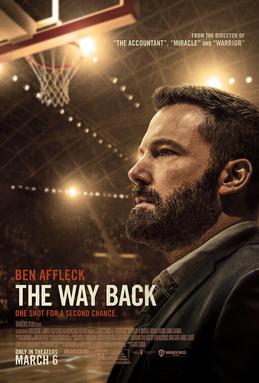
The Way Back, directed by Gavin O'Connor and starring Ben Affleck, is a simple story about a former superstar athlete who allows life challenges to dictate his decisions and actions. Affleck's Jack Cunningham is an adult stuck in a cycle of tragedy, regret, and self-loathing. 

He's allowed the angst he feels from things he can't control to overwhelm him so completely that he squanders the opportunities he created for himself. 

The Way Back isn't a great movie. The pace is a bit slow, and the plot pretty thin. Affleck's performance, however, is believable and consistent. The audience roots for the guy even while jeering the decisions he makes through most of the movie. The Way Back isn't a feel-good flick -- the ending isn't pretty, but it's satisfying. 

Sorta like life.