Anthony Hopkins gives what may be the most intimate, subtle, and finest film performance of his career.
Bravo! Bravo!

Anthony Hopkins gives what may be the most intimate, subtle, and finest film performance of his career.
Bravo! Bravo!
I liked the 2017 release of Justice League enough, I guess. I enjoyed the team-building aspect of the flick, and the deep debate within the team about whether they should use a power dropped into their laps to resurrect a dead Superman.
I prefer to watch team-based superheroes debate and argue in the clubhouse more than I enjoy watching them kick invading aliens in the ass.
But in total, the Josh Whedon-polished Justice League was a major disappointment. The plot was choppy and difficult to follow and the movie lacked character development. And man, those jokes! From Bruce Wayne greeting Aquaman with "I hear you talk to fish," to the hijinks of an immature Barry Allen, the jokes stripped away a seriousness from the movie's tone that couldn't be overcome.
Zack Snyder's Justice League remedies most of the issues I had with the 2017 film. The use of Steppenwolf and his role as an herald of sorts to Darkseid is much improved in the Snyder cut, making this movie more cohesive. Characters are better developed -- how could they not be with twice the run-time of the original? -- and the tone is more serious. Banter is an important component to superhero stories. But it was a distraction in the Whedon-produced film.
It's not that in the Snyder cut.
There remain small issues I have with the movie. I still hate -- I mean really, really hate! -- this version of The Flash. This character seems a hodgepodge of Barry Allen, Wally West, and Bart Allen, and I was annoyed every time he was part of a scene. Cyborg is a little too robotic for me, although that's a creative decision with which I can live. But this version of Aquaman is more serious and much more fun to watch than he was in his own movie, Wonder Woman's character is consistent, and Bruce Wayne is better portrayed by Ben Affleck than he is by any actor not named Bale.
People will debate the four-hour run time, and that debate is legit. Is it necessary, or is it a vanity play by Snyder? I think it's necessary. It allows the time to build a better foundation for plot and character development, and gives appropriate time to explore some of the plot devices glossed over in the previous film.

Recently I joined a Facebook group called “Old Guys Who Love Old Comics.”
Because, well . . . I am, and I do.
What's not to love about old comics? Readable stories. Wonderful hand-drawn panels. That smell when you pull a 40-year-old comic from a plastic bag.
That’s the sweet smell of nostalgia.
But old guy? Really? When did I qualify to be a member of that group?
Despite my mildly arthritic fingers hurting a little as I type this post, I don’t envision myself an old man. Hell, I don’t even think of myself as a middle-aged man. Especially when we’re talking about my lifetime of loving comics.
It seems just a few years ago that I first spent 25 cents for the latest issue of Superman at the local Ben Franklin store. We lived several miles outside the city limits, so going to town was a big deal. Whoever I was with -- usually my parents, but sometimes my grandparents -- usually made the trip special. We'd hit whatever store we drove in for first, then walk down to the five and dime for some candy and some comic books.
I'd read the titles in the back seat on the drive home, all the while hoping I didn't get car sick and puke all over my books. If I still had comics to read when I got home I'd take a short hike into the woods, find a soft spot under a tree, and read until I was finished.
That would have been around 1975.
46 years ago.
I am, and I do.

Mank, the biopic of screenwriter Herman Mankiewicz, is a better movie than any of the films the real-life Mank wrote.
(Except Citizen Kane, of course. It's not better than that. . . . )
But yeah, everything else.
Polish up those Oscars.


In addition to the kayfabe culture, "turns" were what made pre-Vince professional 'rasslin' great. Face turns -- when villains became the good guys -- were fun, but it was heel turns that were the most exciting.
When your favorite good guy went bad it hurt, man. It hurt deep into your soul.
Smart marks could often see a turn coming;. Weeks before, the blonde-haired good guy started showing dark roots, or the villain who always cheated to win gets over by pinning his opponent in the middle of the ring. Most -- but not all -- turns were predictable: fans were never surprised to see Ric Flair turn, but we were shocked when Hulk Hogan joined nWo.
I Care A Lot seemed to have more heel turns in two hours than World Championship Wrestling had throughout the '80s. The turns were fun to watch, and I didn't see any of them coming.

The coal trucks were driven off the mountain and past my house in a predictable order. It was an order determined, I guessed, by how far their destination was from the tipple.
The red truck was my favorite. For weeks, during the summer of 1975, I hid behind a bush near the road and waited for that truck to drive by. At each pass I'd jump from behind the bush and use a pretend-gun stick to shoot at the driver who would pretend-shoot back. I'd stagger as if hit, then fall backward onto the grass as he blasted his horn in triumph.
We carried out this routine every single day, every single pass. Until suddenly we didn't. The red truck -- and all the other trucks, too -- one day just stopped driving by.
It was my first lesson in how our lives and livelihoods are controlled by others. Especially by those who have the power that comes with big money. The sort of money that can pay a guy to haul coal until it's no longer profitable to do so, and the sort of power that allows The Man to not worry about how a trucker will feed his family after the coal mine is closed and his job is terminated.
Chloé Zhao's Nomadland reminded me of that trucker and others I've known who are forced to alter their lifestyle and reimagine their dreams because the work they carried out for most of their lives was no longer useful to The Man. That's the context behind this movie: the main manufacturing company in Empire, Nevada shuts down, forcing hundreds of employees to relocate and killing the town of Empire. Widowed Fern chooses to become a van dweller, a nomadic lifestyle in which people travel from job to job while living in their vehicle. Fern and others form a loose-knit community, and run into each other time and again as they travel their circuitous route.
Members of this community refuse to say "goodbye" when they split up. Instead, they'll "see you on down the road."
Nomadland is beautifully shot, with Academy Award-worthy performances by Frances McDormand and David Strathairn. Director Zhao is patient and allows the story to naturally unfold. While the film is not politically themed, I couldn't help but think of it from that perspective. Is the nomad lifestyle one that's chosen through free will, or is it forced upon people who are marginalized in society?
Is Fern living this lifestyle because she loves it, or because she has no other choice?
Considering that question for more than a moment is a waste of time. It doesn't matter why Fern embraced the nomad lifestyle. She did. The beauty of the film is watching as she lives every single moment of her life. This lifestyle doesn't lend itself to waste or want; you live in the moment or you don't survive.
And perhaps that's a lesson for us all.
One interesting aspect on Nomadland is that real-life nomads play fictionalized versions of themselves, adding true depth and genuineness. Casting this group allows the peek behind the curtain to feel real, almost as if one is watching a documentary. I fell in love with Linda May, Swanky, and Bob. They're happy, kind people who care for others in their community.
Exactly the sort of people I hope to see again some day on down the road.

After the end credits, I cranked up the Internet to read some review of Palmer.
"Justin Timberlake aims for redemption in familiar drama," one review read, while others described it as "heartfelt but familiar," with a plot that contained "familiar material."
Familiar? Seriously?
When is the last time you watched a mainstream movie about a pre-teen boy who, despite being bullied by classmates, stays unflinching true to himself?
Name that movie where a child remains unwavering, despite being told constantly by almost everyone in his life that his perception of himself, his likes and interests, and his loyalties are wrong?
Where are all those movies with the familiar plot about a young child who is a better parent to his mother than she is to him?
Familiar my ass.
There are certainly parts of Palmer that are familiar. But any critic that describes Palmer as "familiar" isn't paying enough attention to Sam, a memorable character. made greater by the superb acting of Ryder Allen. He brings a genuineness and sincerity to a role that likely would have come across as flat and two-dimensional in the hands of a lessor-skilled actor.
Oh yeah, Justin Timberlake was pretty good as Palmer, the guy who learns from Sam that diversity and acceptance makes us better people. I wish Timberlake made more movies, he's a solid actor.

Most things in life that hold any real value are worth the efforts necessary for you to achieve them.
That's true for finding love, developing friendships, maintaining life quality, and having personal and professional integrity. And, of course, it's also true about finding historic artifacts buried deep within the earth.
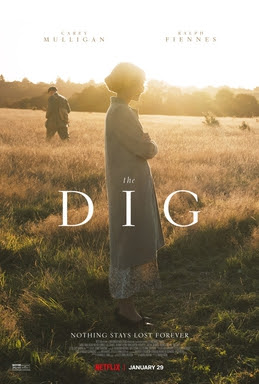
All those things are on display in Simon Stone's mostly-true re-telling of the 1939 Sutton Hoo excavation, which uncovered Anglo-Saxon artifacts that changed how we understand our history.
The Dig is beautifully shot, well-paced, and consistent. Carey Mulligan, Ralph Fiennes, and the rest of the cast deliver top shelf performances. For me, however, the strength of the film rests in the use of metaphor to explain what's going on in the lives of the lead actors. Those comparisons are subtle, yet powerful.
The Dig is well worth your investment.